Choosing a void suit is the first major decision of every Blood Battle Mahjong round. Beginners pick the suit with fewest tiles and move on. Advanced players treat void suit selection as a strategic weapon — one that shapes not just their own hand but the entire table dynamic. This guide goes beyond the basics and covers the situations where the obvious choice is wrong.
1. The Basic Rule (and Why It Is Often Wrong)
The beginner rule: void the suit with fewest tiles after the exchange. This is correct most of the time — fewer tiles to clear means less work. But it ignores three critical factors:
- Connectivity: A suit with 3 isolated tiles is easier to clear than a suit with 4 tiles that include a pair and a partial sequence.
- Hand direction: Your void choice determines which two suits you will build in. Choosing the wrong void locks you into a weaker active hand.
- Fan value: If one of your active suits has strong Pure One Suit potential, keeping both that suit and the adjacent suit for sequences may be better than voiding one of them.
2. Connectivity Analysis
Before choosing your void, quickly rate each suit by connectivity:
| Tile Pattern | Connectivity | Keep or Void? |
|---|---|---|
| Pair (e.g., 5-5) | High — Pong candidate or pair | Keep |
| Two-sided sequence (e.g., 4-5) | High — waits for 3 or 6 | Keep |
| Middle wait (e.g., 4-6) | Medium — waits for 5 | Keep if few tiles |
| Two isolated tiles (e.g., 2-8) | Low — no sequence possible | Void candidate |
| Single isolated tile (e.g., 7) | None | Void immediately |
| Three isolated tiles (e.g., 1-5-9) | None | Strong void candidate |
Example: you have 3 Tiao tiles (3-6-9) and 4 Wan tiles (4-4-7-8). The obvious choice is void Tiao (fewer tiles). But Tiao has no connectivity (three isolated ranks), while Wan has a pair (4-4) and a partial sequence (7-8). Void Tiao — the basic rule is correct here. But if Tiao were 5-6-9 (partial sequence 5-6 plus isolated 9) and Wan were 2-5-8-J (four isolated tiles), voiding Wan would be better despite having more tiles.
3. The Pair Trap
The most common advanced mistake: voiding a suit that contains your best pair because it has fewer tiles. Pairs are precious — they become Pong candidates (triplets), Seven Pairs contributions, or your final winning pair. Losing a pair to the void costs more than losing an equal number of isolated tiles.
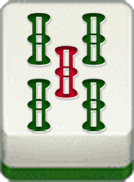
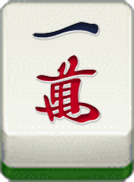
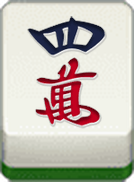


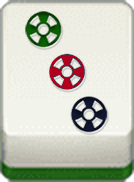
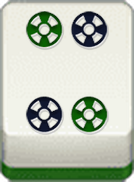
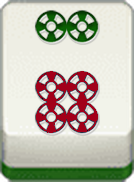
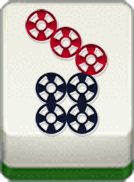
Tiao has 3 tiles but contains a pair. Wan has 3 tiles but all isolated. Tong has 4 tiles with two complete partial sequences. Correct void: Wan. The pair in Tiao and the sequences in Tong are more valuable than saving one extra discard.
4. Voiding Toward Pure One Suit
When one suit has exceptional concentration (8+ tiles with strong connectivity), consider voiding two suits — one in the exchange and one during early play. This is the Pure One Suit path, and the void strategy changes:
- Declare your primary void suit during the exchange (give all tiles from your weakest suit).
- Identify your target suit — the one with the most tiles and best connectivity.
- Treat your third suit as a secondary void — keep its tiles only temporarily, discarding them as target suit tiles come in.
- By turn 8, your hand should be entirely in your target suit.
5. When to Switch Void Suits Mid-Round
Void suit switching mid-round is almost always a mistake — but there are rare correct scenarios:
- You receive three tiles in the exchange that are entirely from your declared void suit. If the exchange fills your void suit, re-evaluate immediately. You may now have fewer tiles in a different suit.
- You draw four consecutive void suit tiles. Probability says this happens roughly 1% of the time. If it does, assess: is the new distribution better for a different void?
- Your active suits are catastrophically bad. If you enter play and realize your two active suits are completely disconnected, and your void suit tiles are actually your best material, briefly consider a pivot — but only if you are still in turns 1–3.
6. Reading Opponents' Void Suits
Just as you choose a void, your opponents do too. Their early discards reveal which suit they have voided. This information is valuable:
- An opponent discards 3+ tiles from the same suit in turns 1–5. That suit is their void. Stop expecting Pong calls on those tiles from them.
- An opponent keeps a suit entirely. That is their active suit. Be cautious discarding tiles from it that they could Pong.
- Two opponents void the same suit. That suit's tiles are safer to discard — neither will Pong. But it also means that suit's tiles are flooding into the discard pool, which may help you if you need them.
7. Advanced: Void Suit as Deception
Expert players occasionally maintain ambiguity about their void suit to prevent opponents from reading their hand direction. Instead of clearing the void suit in turns 1–4, they mix in one or two void suit discards among other tiles. This costs tempo but conceals which suits are your active suits.
This deception is only worthwhile when:
- You are playing a high-value hand that benefits from concealment (Pure One Suit closed hand).
- You have few void suit tiles (1–2) that can be delayed without hurting you.
- An opponent has already started counter-discarding into your active suit based on reading your pattern.
In most rounds, clear your void suit fast and directly. The tempo advantage of early void clearing outweighs the marginal benefit of hand concealment.