If you have never played mahjong before, the very first thing you need to do is learn to read the tiles. Unlike playing cards, mahjong tiles do not have a universal design — they come in suits and ranks that feel unfamiliar at first glance. The good news: Blood Battle Mahjong uses only 3 suits and no special tiles, making it one of the most beginner-friendly mahjong variants to learn visually. Once you know the 27 unique tile types, you know the entire tile set.
This guide walks through every single tile in the game — what it looks like, how to recognize it, and why it matters for building a winning hand. Every concept is illustrated with actual tile images so you can connect the visual to the name immediately.
1. The Complete Tile Set: 108 Tiles
The Blood Battle Mahjong tile set contains exactly 108 tiles. There are 3 suits — Wan, Tiao, and Tong — each with 9 ranks (1 through 9), and each unique tile appears exactly 4 times:
| Suit | English Name | Chinese Name | Ranks | Copies Each | Total |
|---|---|---|---|---|---|
| Wan | Characters | 1–9 | 4 | 36 | |
| Tiao | Bamboo | 1–9 | 4 | 36 | |
| Tong | Circles / Dots | 1–9 | 4 | 36 | |
| Grand Total | 108 |
That is it. No wind tiles (East, South, West, North). No dragon tiles (Red, Green, White). No flower tiles. Blood Battle strips mahjong down to its essential core — 3 suits, 9 ranks each. This is actually one of the reasons Blood Battle is so popular: the absence of honor tiles removes a lot of memorization overhead and keeps strategic focus tightly on suit composition and set building.
2. The Wan Suit — Characters
The Wan suit is named after the Chinese character (wàn), meaning "ten thousand." Each Wan tile displays large, bold Chinese numerals in its center. Even if you have never studied Chinese, you will quickly recognize the Wan suit on sight — the prominent character design makes it visually distinct from both Tiao and Tong.
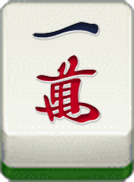
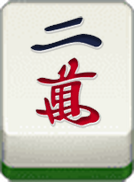
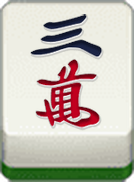
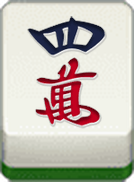
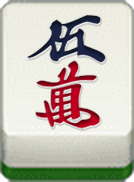
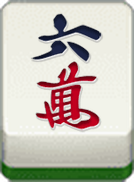
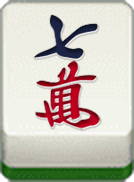
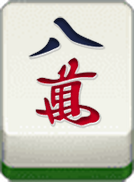
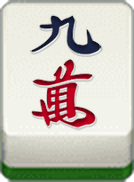
Here is what to look for when identifying Wan tiles:
- Every Wan tile has a large central Chinese character — this is the most reliable visual marker
- The rank number is also shown in smaller form at the top of the tile (usually in red or black numerals)
- The suit character often appears below or alongside the rank character
- 1 Wan and 9 Wan are the terminals of this suit — they have fewer options for forming sequences
- 5 Wan sits in the center of the suit — it is the most flexible tile, able to connect in either direction
Wan Tiles by Range
Let us look at the Wan tiles in three groups to make their visual progression clear:
3. The Tiao Suit — Bamboo
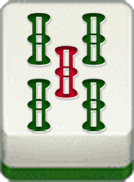
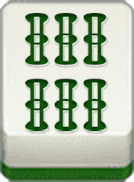
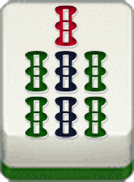
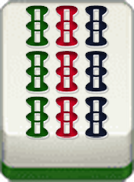
Tiao tiles show clusters of bamboo sticks arranged in various configurations. The rank corresponds to the number of bamboo segments displayed on the tile. The Tiao suit tends to have a predominantly green visual design, making it easy to separate from Tong (which uses blue and red tones).

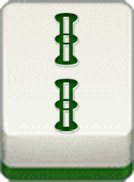
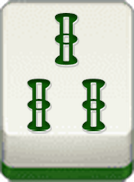
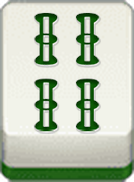

Tips for recognizing Tiao tiles quickly:
- 1 Tiao looks completely different from all other Tiao tiles — instead of bamboo sticks, it typically shows a bird or a single large ornate design. This is a traditional mahjong feature, not a typo. Once you know this, you will never misread 1 Tiao again
- 2 Tiao through 9 Tiao show progressively more bamboo segments in vertical arrangements
- The green color scheme is the fastest way to identify Tiao at a glance
- When in doubt, look for the character on the tile face
4. The Tong Suit — Circles / Dots
Tong tiles display circular dot patterns. The rank corresponds to the number of circles on the tile. Tong is often the easiest suit for new Western players to learn quickly — counting dots is immediately intuitive. The visual arrangement of dots follows consistent geometric patterns that your eye will learn to recognize without counting.


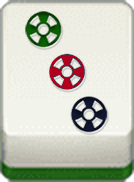
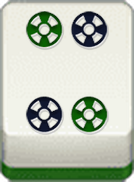
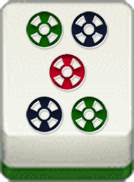
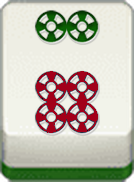
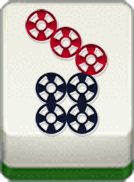
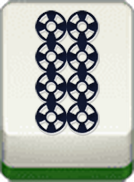
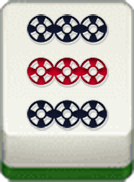
Tips for recognizing Tong tiles:
- 1 Tong is a single large circle filling most of the tile face — unmistakable
- 2 Tong shows two circles in a vertical column
- 4 Tong shows a 2×2 grid of circles
- 9 Tong shows a 3×3 grid of 9 circles — the most visually complex tile in the suit
- The character appears on most Tong tile designs to confirm the suit
5. Terminals vs. Simples
Within every suit, tiles are divided into two important categories based on their rank: terminals and simples. Understanding this distinction is critical because it directly affects which tiles are easiest to use and which ones you should consider discarding early.
| Category | Ranks | Tiles in the Game | Sequence Flexibility |
|---|---|---|---|
| Terminals (yāo jiǔ) | 1 and 9 only | 1 Wan, 9 Wan, 1 Tiao, 9 Tiao, 1 Tong, 9 Tong (6 unique tiles) | Can only form one sequence each |
| Simples (zhōngzhāng) | 2 through 8 | All 2, 3, 4, 5, 6, 7, 8 in all 3 suits (21 unique tiles) | Can form sequences in multiple directions |
Why Terminals Are Harder to Use
A sequence requires 3 consecutive tiles of the same suit. Consider a middle tile like 5 Wan — it can participate in three different sequences: 3-4-5, 4-5-6, or 5-6-7. That gives you many paths to complete a set. Now consider 1 Wan — it can only appear in the sequence 1-2-3. And 9 Wan can only appear in 7-8-9. This severely limits their utility when isolated.
The practical implication: if you hold an isolated terminal (a 1 or 9 with no adjacent tiles of the same suit in your hand), it is usually the weakest tile you have. An isolated 1 Wan requires you to draw both 2 Wan and 3 Wan to complete a sequence around it. Compare that to an isolated 5 Wan, which could complete a sequence by drawing any one of several tiles: 3, 4, 6, or 7 Wan depending on what you already hold.
6. What Is a Sequence ?
A sequence (shùnzi) is a set of 3 consecutive tiles from the same suit. Sequences are the most common type of set in Blood Battle Mahjong. You need 4 sets to win (some or all of which can be sequences), plus 1 pair.
Critical rule: sequences must use tiles from the same suit only. You cannot mix suits. Also, in Blood Battle Mahjong, you cannot claim another player's discard to form a sequence (there is no Chi / Chow). Sequences can only be built from tiles you draw yourself from the wall.
Five Sequence Examples
7. What Is a Triplet ?
A triplet (kèzi) is a set of 3 identical tiles — same suit, same rank. Any tile in the game can form a triplet. Since there are 4 copies of every tile, you can always collect 3 copies of any tile (depending on what is available in the wall and what opponents have held).
A winning hand built entirely of triplets (and no sequences) has a special name: Peng Peng Hu , worth 2 fan — double the base payout. This is one of the most satisfying hands to build when your tiles align.
Three Triplet Examples
How do you collect triplets? Two ways:
- Draw them yourself: you already hold 2 copies of a tile and draw the 3rd from the wall
- Declare Pong: when any opponent discards a tile and you hold 2 copies, you can call "Pong" to claim that discard and reveal the completed triplet as an open meld on the table
8. What Is a Pair ?
A pair (duìzi) is exactly 2 identical tiles — same suit, same rank. Every standard winning hand in Blood Battle Mahjong requires exactly one pair, known as the "eyes" (jiàng) of the hand. The pair completes the 14-tile hand structure: 4 sets × 3 tiles each + 1 pair × 2 tiles = 14 tiles total.
Any tile can be the pair. There is no restriction — a pair of 1 Wan, a pair of 9 Tiao, or a pair of 5 Tong are all equally valid. The pair in your hand is often one of the last things you decide — you build your 4 sets first, and whatever tile you hold 2 copies of without a better use becomes your pair.
9. What Is a Kong ?
A Kong (gàng) — sometimes called a "quad" — happens when you collect all 4 copies of the same tile. A Kong counts as one set in your winning hand (like a super-triplet), and it comes with a valuable bonus: you draw an extra tile from the wall after declaring a Kong.
There are multiple ways a Kong can happen:
- Concealed Kong : you draw the 4th copy of a tile you already hold 3 of — entirely from your own draws
- Open Kong : you declare Pong on an opponent's discard (making an open triplet), then later draw the 4th copy from the wall
- Added Kong : you already have an open Pong on the table, and you draw the 4th copy, adding it to your existing meld
10. Putting It All Together: Hand Structure
Now that you know the tile types and the 4 building blocks (sequences, triplets, pairs, Kongs), let us see how they combine into a complete winning hand.
The standard Blood Battle winning hand has exactly 14 tiles: 4 sets + 1 pair.
The other valid winning structure is 7 Pairs — exactly 7 pairs of identical tiles, worth 2 fan:
11. Reading the Discard Pile
You can only see your own tiles and any tiles that have been revealed through discards or open Pong/Kong declarations. The discard pile is a critical source of information. Here is what to watch for:
- Counting copies: If you have seen 3 copies of a tile already discarded, you know the 4th copy is still live — in someone's hand or in the wall. If all 4 copies have been discarded, that tile is dead
- Safe tiles: A tile recently discarded by an opponent is generally safer to discard yourself — they already passed on it
- Suit focus reading: If an opponent keeps discarding Wan tiles, they are probably not building a Wan hand — their focus is on Tiao and/or Tong
12. Tile Frequency and Its Importance
Because there are exactly 4 copies of every tile, and 4 players draw from the same wall, tiles become progressively rarer as the game goes on:
- Early in the game, most tiles are still available — you have more time to wait for key draws
- Late in the game, with few tiles left in the wall, you must assess whether the tile you need is still realistically available
- If you hold 2 copies of a tile and want a 3rd for a triplet, there are 2 copies remaining — your Pong claim on a discard is a valid strategy
- Wan
- The Characters suit. Tiles display large Chinese numerals. Ranks 1–9, 4 copies each, 36 tiles total.
- Tiao
- The Bamboo suit. Tiles display bamboo stick cluster patterns. Ranks 1–9. Important: 1 Tiao often shows a bird design, not bamboo sticks.
- Tong
- The Circles / Dots suit. Tiles display circular dot patterns. Ranks 1–9. Usually the easiest suit for beginners to count.
- Terminal
- Rank 1 or rank 9 tiles in any suit. They have only one valid sequence direction and are harder to use when isolated. Six terminal tiles total across the 3 suits.
- Simple
- Ranks 2 through 8. These tiles have the most flexibility for forming sequences. The backbone of most winning hands.
- Sequence (shùnzi)
- Three consecutive tiles of the same suit. Example: 4-5-6 Tiao. Cannot mix suits. Cannot be formed by claiming a discard in Blood Battle (no Chi rule).
- Triplet (kèzi)
- Three identical tiles — same suit, same rank. Example: three 7 Tiao. Can be formed by claiming a discard via Pong.
- Kong (gàng)
- All 4 copies of the same tile. Counts as one set and grants a bonus draw from the wall. Three types: concealed, open, added.
- Pair (duìzi)
- Two identical tiles — the 'eyes' of a winning hand. Every standard winning hand requires exactly one pair.
- Pong
- A declaration to claim an opponent's discard to complete a triplet. The triplet becomes an open (visible) meld on the table.
- 7 Pairs
- A special winning hand consisting of exactly 7 pairs of identical tiles, totaling 14 tiles. Worth 2 fan.
- Flower Pig
- A penalty triggered when you still hold tiles from your declared void suit when the wall runs out. Avoid by discarding void suit tiles aggressively.