Being in tenpai means your hand is one tile away from winning. But how you wait matters enormously. Two players can both be in tenpai, yet one waits on 4 different tiles while the other waits on just 1. The difference is the waiting shape — the structure formed by the incomplete portion of your hand. This guide explains every waiting shape in Blood Battle Mahjong and how to evaluate them.
1. What Is a Waiting Shape?
When you are in tenpai, your hand has 13 tiles and needs exactly one more to complete. The incomplete part of your hand — the set that is missing one tile — forms a waiting shape. The shape determines which tiles you are waiting for and how many distinct tiles can complete your hand.
More winning tiles = wider wait = faster win. Fewer winning tiles = narrower wait = slower, but sometimes higher-value hand.
2. Two-Sided Wait (Liǎng Miàn)
Two adjacent middle tiles waiting for either end. This is the strongest and most common wait.
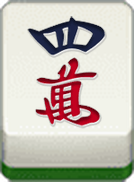
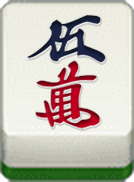
You hold 4-wan and 5-wan. Any 3-wan completes the sequence 3-4-5. Any 6-wan completes 4-5-6. Two tile types, four copies each = eight tiles that can complete your hand. This is why two-sided waits win fastest.
3. Middle Wait (Kǎn Zhāng)
Two tiles with a gap in the middle, waiting for the tile between them.
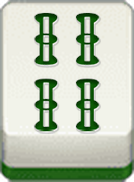
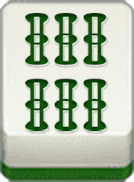
You hold 4-tiao and 6-tiao. Only 5-tiao completes the sequence 4-5-6. Just four tiles can win for you. This wait is narrow. Avoid it when you have alternatives, but it often appears naturally in complex hands.
4. Edge Wait (Biān Zhāng)
A sequence at the end of the suit, waiting for only one possible tile.


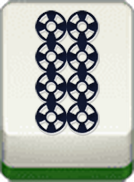
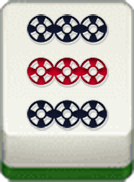
Holding 1-2 can only be completed by 3 (forming 1-2-3). Holding 8-9 can only be completed by 7. Edge waits are the weakest shape — they wait on just one tile type. Escape edge waits whenever possible by drawing the appropriate neighbor tile.
5. Single Tile Wait (Dān Diào)
Your four sets are complete, but your pair (the "eyes") is missing its second tile. You are waiting for one specific tile to form the pair.
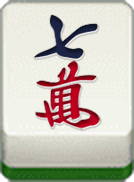
Only three copies of that tile remain in the deck (one is in your hand already). Single tile wait is very narrow, but it is sometimes forced when your four sets are built around a specific pair tile.
6. Dual Pong Wait (Shuāng Pèng)
You hold two separate pairs. One pair will become your final winning pair; the other needs a third matching tile to become a Pong set. You are waiting on either of two different tiles.
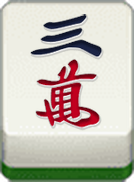

If 3-wan arrives: 3-wan becomes a Pong, 8-8-tiao becomes your pair. If 8-tiao arrives: 8-tiao becomes a Pong, 3-3-wan becomes your pair. This gives you 6 winning tiles total (3 copies of each), making it a surprisingly strong wait.
7. Multi-Sided Wait (Duō Miàn)
Advanced hands can create waits on three, four, or even more different tiles simultaneously. These usually arise from running sequences or complex combinations.
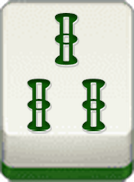
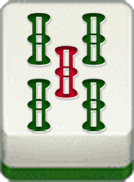
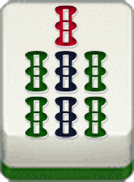
Five consecutive tiles like 3-4-5-6-7 can be completed in three ways: 2 (completing 2-3-4 + 5-6-7), 5 (completing 3-4-5 + 5-6-7 as two sets sharing the 5, actually needing careful counting), or 8 (completing 3-4-5 + 6-7-8). Multi-sided waits are powerful but require careful construction.
8. Comparing Wait Strength
| Wait Type | Waiting Tiles | Deck Copies | Speed |
|---|---|---|---|
| Two-Sided | 2 tile types | Up to 8 | Fastest |
| Dual Pong | 2 tile types | Up to 6 | Fast |
| Multi-Sided | 3+ tile types | Up to 12+ | Fastest (rare) |
| Middle | 1 tile type | Up to 4 | Slow |
| Edge | 1 tile type | Up to 4 | Slow |
| Single | 1 tile type | Up to 3 | Slowest |
9. Choosing Your Wait Shape
When you approach tenpai, you often have a choice of which tile to discard last — and that choice determines your waiting shape. Follow these priorities:
- Two-sided > Dual Pong > Middle > Edge > Single. Given any choice, pick the wider wait.
- Count remaining tiles. If opponents have discarded 3 copies of your winning tile, the fourth is nearly unavailable. Reconsider.
- Balance wait width against hand value. A single-tile wait that gives you 4 fan may be better than a two-sided wait that gives you 1 fan.
- Self-draw potential. Wider waits mean more chances to draw your tile from the wall, which pays triple.
10. Practice Drill
Look at any tenpai hand and ask yourself: what is my waiting shape? How many distinct tiles can complete my hand? How many total copies are there? Could I have discarded differently to get a wider wait? Running this mental check every round will sharpen your tenpai decisions faster than any other practice.