You have played a few rounds of Blood Battle Mahjong and you are starting to notice when Pong and Kong buttons appear. Now you need to know the deeper question: should you actually claim that tile? This guide walks through every Pong and Kong scenario, the decision framework for when to claim versus pass, and the three different Kong types that each work differently.
| Action | Chinese | What It Does | Allowed? |
|---|---|---|---|
| Pong | (pèng) | Claim discard to complete a triplet (3 identical tiles) | Yes — any player's discard |
| Kong | (gàng) | Form a quadruplet (4 identical tiles) — draws a bonus tile | Yes — three types |
| Chi | (chī) | Claim discard to complete a sequence | No — never in Blood Battle |
1. What Is Pong ?
Pong lets you claim any player's discard to complete a triplet. To Pong, you must already hold 2 copies of the discarded tile in your hand. After ponging:
- The 3-tile triplet is placed face-up in front of you (exposed meld)
- You must immediately discard one tile from your remaining hand
- Play continues to the left of you (you effectively "cut in" on the turn order)
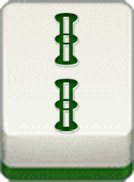
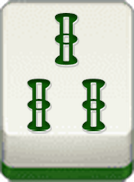
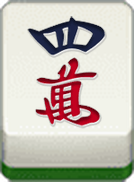
Pong Example: Claiming 7-wan
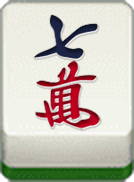
After this Pong, you must discard one tile from your remaining 10-tile hand. Choose wisely — discard your void suit tiles first, then isolated tiles with no connections.
Pong Example: Building toward Peng Peng Hu
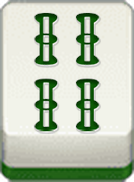
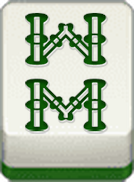
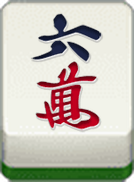
With this structure, you are actively building Peng Peng Hu (all triplets, 2 fan). Ponging any of your existing pairs when opponents discard them is exactly the right play here.
2. What Is Kong ?
A Kong occurs when you collect all 4 identical copies of a tile. Declaring a Kong always earns you immediate payment from opponents and gives you an extra replacement draw from the back of the wall.
There are three distinct types of Kong, each with different payment rules:
Type 1: Concealed Kong (àn gàng)
You draw the 4th copy of a tile you already have 3 of in your concealed hand. All 4 tiles come from your own draws — no claiming from discards. You declare it on your turn.

Concealed Kongs are placed with the two middle tiles face-down to signal they are hidden. All 3 other active players each pay 2× base rate. Then you draw a replacement tile.
Type 2: Exposed Kong (míng gàng)
An opponent discards a tile you already hold 3 copies of. You claim it to form an exposed Kong. The set is placed fully face-up. Only the player who discarded pays — 2× base rate.
Type 3: Extended Kong (bǔ gàng)
You already have an exposed Pong of a tile on the table, and you draw the 4th copy from the wall. You extend the Pong into a Kong. All 3 other active players each pay 1× base rate.
3. Kong Payment Summary
| Kong Type | Source of 4th Tile | Who Pays | Amount |
|---|---|---|---|
| Concealed Kong | Drawn from wall | All 3 active opponents | 2× base rate each |
| Exposed Kong | Claimed discard | Only the discarder | 2× base rate |
| Extended Kong | Drawn to extend existing Pong | All 3 active opponents | 1× base rate each |
After all Kong payments are collected, you draw a replacement tile from the back of the wall. You can win off this replacement tile — if you do, it is called Kong Blossom (gàng shàng kāi huā), earning +1 fan.
4. Should You Pong? The Decision Framework
Every time a Pong button appears, you face a decision. Here is how to think through it quickly:
Reasons to Pong
- Builds your main suit: Ponging a tile in your dominant suit advances your hand and reduces the tiles you still need
- Targets Peng Peng Hu: If you are building an all-triplets hand, every Pong is a step toward a 2-fan win
- Discard opportunity: Ponging lets you discard one tile — if you need to shed a bad tile from your hand, Ponging can be a vehicle for that
- You are far from tenpai: Ponging with 3 tiles still needed is more efficient than waiting for the wall
Reasons NOT to Pong
- It is your void suit: Never Pong a void suit tile — you cannot win with an exposed void suit meld and have no way to recover
- You are targeting Ping Hu: Ponging forces an open meld, which may reduce fan for sequences-only hands
- You are targeting 7 Pairs: Any Pong permanently closes the Seven Pairs path for this round
- Ponging breaks a near-complete sequence: If you need that pair tile to complete a sequence, ponging removes 2 of those tiles from your hand
- Your hand is almost complete: If you only need 1-2 more tiles to win, Ponging and being forced to discard could break your tenpai state
- You do not want to reveal your suit: Every exposed meld tells opponents exactly what you are working with — sometimes information control matters more than one set
5. Should You Kong? The Kong Decision
Kongs are generally beneficial — you get immediate payment and an extra draw. But there are still situations to think through:
Concealed Kong: Almost Always Declare It
Concealed Kongs are the strongest form. They earn the highest payment (2× from all opponents), reveal the least information (middle tiles hidden), and give you an extra draw. The only reason to hesitate: you need that tile configuration as a triplet-plus-pair for a very specific hand structure. This is rare.


Exposed Kong: Think Before Claiming
Claiming an opponent's discard for an Exposed Kong shows all 4 tiles publicly. Think twice if:
- Your hand structure is nearly complete and the replacement draw could disrupt it
- You are close to tenpai and want to keep your hand flexible
- The single-player payment (only the discarder pays) may not be worth the information revealed
Extended Kong: Check for Rob the Kong Risk
Before extending a Pong into a Kong, scan the discard pile. If the tile you are extending is a common middle-rank tile (4, 5, 6) that many hand structures want, the Rob the Kong risk is higher. Terminal tiles (1, 2, 8, 9) are generally safer to extend.
6. Priority Order When a Tile Is Discarded
When a player discards a tile, multiple players might want to react. The order is strict:
- Win — highest priority. Any player can declare a win off a discard before anything else happens.
- Kong — if nobody wins, a player with 3 copies can Kong.
- Pong — if nobody wins or Kongs, a player with 2 copies can Pong.
- Normal Draw — if nobody reacts, the next player in turn draws from the wall.
7. Three Worked Scenarios: Should I Pong?
Scenario A: Strong Hand, Right Suit — Pong It
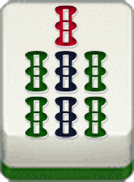
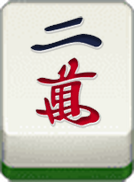
Decision: Pong the 7-tiao. You are building Pure Suit tiao. The 7-7-7 tiao triplet completes one of your needed sets. Discard the isolated 2-wan after ponging. You will be very close to tenpai.
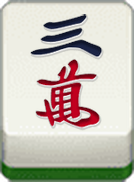
Scenario B: Near Tenpai — Pass on the Pong
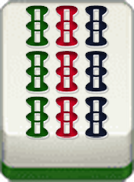
Decision: Pass. You are one tile from tenpai — just need to discard the extra wan tiles. Ponging 3-wan creates an exposed triplet and forces a discard that likely breaks your near-complete tiao structure. Wait for your winning tile instead.
Scenario C: Void Suit Tile — Never Pong
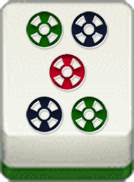
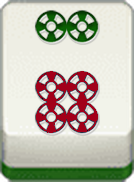
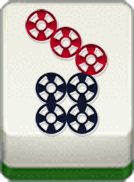

Decision: Never Pong. These are void suit tiles — you should have discarded the 4-4 wan immediately after declaring wan as your void suit. Ponging here creates an exposed meld of your void suit and permanently locks your hand into an unwinnable state. Discard both wan tiles on your next available turns.
8. On realmahjong.ai
When playing on realmahjong.ai, the Pong and Kong buttons appear automatically whenever a claimable tile is discarded. The game also:
- Automatically prevents Ponging or Konging your void suit tiles
- Shows all three Kong types clearly labeled when applicable
- Displays tenpai hints so you can evaluate whether claiming a tile helps or hurts your progress
- Calculates Kong payments immediately and updates all players' scores
Even with automatic protections, you will make better decisions faster by understanding the underlying logic — especially the Pong/pass decision when you are 1-2 tiles from tenpai.
- Pong: hold 2 copies + claim discard → face-up triplet → discard one tile
- Concealed Kong: draw 4th copy → all pay 2× → extra draw
- Exposed Kong: hold 3 + claim discard → discarder pays 2× → extra draw
- Extended Kong: draw 4th to extend Pong → all pay 1× → extra draw → Rob the Kong risk
- Never Pong or Kong your void suit
- Priority order: Win > Kong > Pong > Normal Draw