When you draw a third tile of a kind, you face a recurring decision: Pong to form a triplet set, or keep the pair and pursue sequences? This choice appears dozens of times across a session and has no universal answer. The right decision depends on your hand shape, the fan patterns you are targeting, your current shanten count, and what opponents are doing. This guide gives you a framework for making this decision correctly every time.
1. What a Pair and Triplet Both Offer
| Feature | Pair | Triplet / Pong Set |
|---|---|---|
| Counts as a complete set? | No (only as the "eyes" / final pair) | Yes (one of four required sets) |
| Contributes to All Pong? | No (must become triplet) | Yes |
| Contributes to Seven Pairs? | Yes (needs 7 pairs) | No |
| Contributes to Flat Hand? | Only as final pair | No (must be sequences only) |
| Requires how many tiles? | 2 (already have) | 3 (one more needed) |
| What blocks it? | Nothing — you have both tiles | If opponents won't discard the tile and you can't draw it |
A pair has immediate hand value — it qualifies as your winning pair right now. A triplet needs one more tile, which costs either a draw or an opponent's discard (Pong). But a triplet is a complete set, which pairs are not.
2. Decision Framework: When to Pong
Ponging is correct when ALL of the following are true:
- You are targeting All Pong. If your hand goal is all triplets, every pair should eventually become a Pong. Ponging moves you directly toward your goal.
- The pair is isolated — no adjacent tiles for sequences. If you hold 2-2-tiao and no 1, 3, or 4-tiao to form sequences, this pair has no sequence future. Pong it into a complete set.
- You are behind on shanten and Ponging improves it immediately. Ponging gives you an instant complete set without drawing. If you need sets and Ponging delivers one, take it.
- The tile is rare in discards and you fear drawing the third copy. Some tiles almost never appear in discards (opponents are using them). If an opponent finally discards one and you have two, Pong — it may be your only chance.
3. Decision Framework: When to Keep the Pair
Keep the pair (decline Pong) when ANY of the following are true:
- You are targeting Flat Hand. Flat Hand requires all four sets to be sequences. A Pong set disqualifies Flat Hand. Keep the pair and build sequences instead.
- You are targeting Seven Pairs. Seven Pairs uses pairs, not triplets. Keep every pair you have — each is one-seventh of your goal.
- You have adjacent tiles that make a sequence better than a triplet. If you hold 5-5-tiao and also hold 4-tiao and 6-tiao, those three tiles form a sequence (4-5-6) while the remaining 5 becomes a flexible tile. Sequence building here outperforms Ponging.
- Ponging would expose your hand direction to all opponents. Every Pong exposes a set on the table. If you are playing a high-value closed hand, Ponging broadcasts your suit and target tiles. Sometimes keeping the pair and drawing the third tile yourself (concealed triplet) is more strategic.
4. The Flat Hand vs All Pong Decision
When you have 3+ pairs in your opening hand, you face the fundamental choice between Flat Hand (all sequences) and All Pong (all triplets). This is not a mid-round decision — commit early.


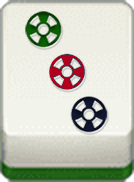
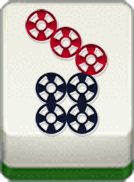
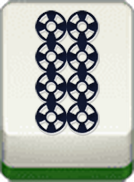
This hand has two paths: Flat Hand (build 4-5-wan and 7-8-tong into sequences, treat 5-5-wan and 3-3-tong as sequence building blocks or the final pair) or All Pong (Pong both pairs into triplets, build two more triplets from other draws). Flat Hand is better here because the sequence shapes (4-5, 7-8) are strong and sequences are faster to complete than triplets when the tiles are this connected.
5. The Seven Pairs Crossroads
When you have 4 or more pairs in your opening hand, Seven Pairs becomes a real path. But every Pong you take destroys a pair. If you have 4 pairs and Pong one of them, you are now 3 pairs into a Seven Pairs attempt that needs 7 — very far behind.
Rule: if you have 4+ pairs and no strong sequence connections, commit to Seven Pairs and Pong nothing. If you have 4 pairs but also multiple sequence shapes (4-5, 7-8), assess which path reaches tenpai faster based on your current outs.
6. Mid-Hand Reassessment
Your pair-vs-triplet strategy should be re-evaluated whenever:
- You draw a tile that gives you a third copy of an existing pair — now you decide.
- An opponent discards a tile you have two of — Pong decision.
- Your shanten count changes significantly (either improving or worsening).
- An opponent reaches tenpai and you need to switch from value to speed.
The fastest reassessment: at each decision point, ask "does this tile (as a Pong) or this pair (kept) move me closer to tenpai faster?" Count shanten for both paths and choose the lower one.
7. Summary Decision Tree
- Targeting All Pong? → Pong every viable pair.
- Targeting Seven Pairs (4+ pairs)? → Keep every pair, Pong nothing.
- Targeting Flat Hand? → Keep pairs as sequence building blocks or the final pair, never Pong.
- Mixed or flexible? → Pong isolated pairs with no sequence future; keep pairs with adjacent tiles.
- Playing closed for fan bonus? → Prefer concealed triplets over exposed Pong sets.