All Pong (Pèng Pèng Hú) is a winning hand where all four sets are triplets — three of a kind — rather than sequences. Every set in your hand must be a Pong or Kong. It is one of the most aggressive hand types in Blood Battle Mahjong: fast to signal, easy to read, but powerful when it comes together before opponents can cut you off.
1. What Makes an All Pong Hand
A standard winning hand has four sets and one pair. In All Pong, every set must be a triplet. Sequences are not allowed. Your completed hand looks like:




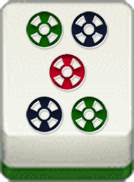
You can use both exposed Pong sets (claimed from discards) and concealed triplets drawn from the wall. Kong sets (four of a kind) also count as triplets for All Pong purposes.
2. Starting an All Pong Hand
All Pong is most viable when your opening 13 tiles (after exchange) contain three or more pairs. Each pair is a potential Pong set waiting for its third tile. The more pairs you start with, the less dependent you are on opponents discarding specific tiles.
- Count pairs after the exchange. Three or more pairs = viable All Pong path.
- Choose your void suit. The suit with fewest tiles and fewest pairs is your void. Clear it fast.
- Identify which pairs to Pong. Not all pairs are equally good. Prioritize pairs in your strongest suit. Isolated pairs with no connectivity to sequences are prime Pong candidates.
- Commit fully. All Pong requires you to avoid building sequences entirely. Sequence tiles that arrive should be discarded unless they form pairs.
3. The Speed Advantage
All Pong is fast because Ponging grants an immediate complete set from an opponent's discard — no drawing required. In the early game, when opponents are still clearing their void suits, discards are plentiful. A player going for All Pong can Pong 2–3 times in the first 8 turns, arriving at tenpai very quickly.
4. The Information Problem
All Pong's biggest weakness: transparency. Every Pong exposes a set on the table. After two Pongs, all opponents can see two of your four target sets. They know your suit focus, your target tiles, and your hand direction. Smart opponents immediately stop discarding tiles you might Pong.
Mitigations:
- Pong across two suits. If you Pong one Wan set and one Tong set, opponents need to avoid two suits instead of one — harder to counter.
- Use concealed triplets. If you draw all three of a tile yourself, you have a concealed triplet. You can declare Kong to get paid without revealing which tile — or simply wait to win without Ponging.
- Mix in a concealed pair for the final set. If you only Pong two sets and keep two concealed, opponents cannot fully read your hand.
5. All Pong vs Pure One Suit
The most powerful All Pong variant is Pure One Suit All Pong — all four triplets from a single suit. This combines (1 fan) + (2 fan) = 3 fan = 8× base payout from a discard, 24× base on self-draw.
To achieve Pure One Suit All Pong, you need enough tiles from one suit to form four triplets (12 tiles) plus a pair (2 more = 14 total). The wall has 9 tiles per non-honor suit (ranks 1–9) × 4 copies = 36 tiles. You need 14 of 36 from one suit. It is ambitious but achievable when your exchange gives you a head start.
6. When All Pong Does Not Work
- Too few pairs after exchange. If you have only 1 pair, you need 3 more triplets entirely from draws — too slow and random.
- Opponents stop discarding your tiles. If opponents identify your suit focus early and all stop discarding it, you must draw everything yourself. Consider switching to a concealed approach.
- The wall is running dry. All Pong depends on Ponging. If the round is in its final 15 tiles and you still need 2 more triplets, switch to tenpai on whatever you have.
7. Sample All Pong Progression
After exchange: pairs of 3-wan, 7-wan, 2-tong, 8-tong, and two isolated Tiao tiles (void Tiao). Turn 1–3: discard all Tiao. Turn 4: opponent discards 3-wan — Pong! Turn 6: opponent discards 2-tong — Pong! Turn 8: draw 7-wan from wall — now have concealed triplet 7-7-7-wan. Turn 9: opponent discards 8-tong — Pong! Now: three exposed triplets (3-wan, 2-tong, 8-tong), one concealed triplet (7-wan), need a pair for the final hand. Draw 5-tong: keep as pair candidate. Tenpai on 5-tong or any other singleton you can pair up.