Blood Battle Mahjong (Xuè Zhàn Dào Dǐ) is a Sichuan-style mahjong variant played by 4 players. It is known for two unique features: no Chi (you cannot claim discards to form sequences) and the Blood Battle rule (the game continues after the first winner until the round fully resolves). This guide walks you through a complete game round from start to finish, step by step.
1. Overview of a Full Round
A Blood Battle Mahjong round follows a clear sequence of phases. Here is the full flow at a glance:
| Phase | What Happens | When |
|---|---|---|
| 1. Deal | Dealer gets 14 tiles, others get 13 each | Round start |
| 2. Tile Exchange | Each player picks 3 same-suit tiles to pass to another player | Before play begins |
| 3. Void Suit Declaration | Each player declares one suit their winning hand will not use | Before play begins |
| 4. Play Turns | Players draw and discard; Pong/Kong claims happen between turns | Main game loop |
| 5. Win Declaration | A player wins; game continues (Blood Battle rule) for remaining players | Repeats up to 3 times |
| 6. Scoring | Fan are calculated, coins exchanged between winners and losers | End of round |
The most important thing to understand upfront: the round does not end when the first player wins. It keeps going — this is the "blood battle" — until either the wall runs out or the remaining players have also won or lost.
2. Step 1 — Dealing the Tiles
At the start of each round, tiles are shuffled and dealt:
- The dealer receives 14 tiles
- Every other player receives 13 tiles
- Remaining tiles form the wall — the draw pile for the round
The dealer gets 14 tiles because they take the first turn without needing to draw — they can immediately assess their 14-tile hand and discard. All other players draw one tile on their first turn to bring their count to 14 before discarding.
Here is an example starting hand of 13 tiles — notice how it spans all 3 suits with no clear shape yet:




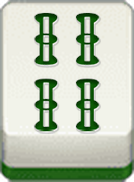
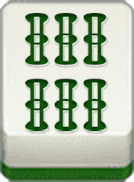
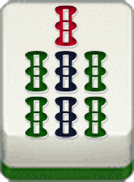
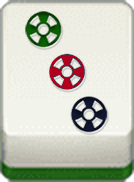
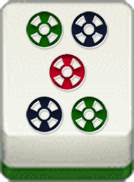
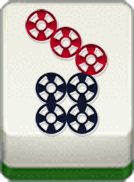
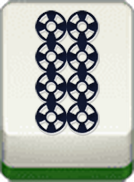
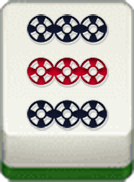
Analysing this hand: the player has scattered Wan tiles, a partial cluster in Tiao (4-6-7 could use a 5), and a strong Tong cluster (3-3 pair, 7-8-9 sequence, 5 Tong isolated). This is a fairly typical starting hand — mixed, with potential in multiple suits. The Wan tiles (isolated 2, 5, 8 with no adjacency) look like the natural void suit candidate.
3. Step 2 — Tile Exchange
Before play begins, every player simultaneously picks 3 tiles of the same suit from their hand to pass to another player. The direction of the pass (left, right, or across) is determined randomly each round — the game interface displays it clearly before you choose.
The exchange rules:
- You must pass exactly 3 tiles
- All 3 tiles must be from the same suit (all 3 Wan, or all 3 Tiao, or all 3 Tong)
- All players pass simultaneously — you do not see what you receive until everyone has chosen
- The direction (left/right/across) is random each round — it changes every round
Here is how the exchange transforms a hand. Before exchange:
The player selects 2 Wan, 5 Wan, and 8 Wan to pass — their most isolated tiles with no adjacency — and receives 3 Tong tiles in return:
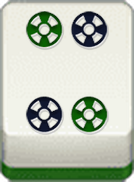
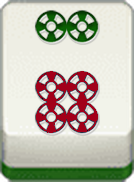
After the exchange, this player has a much cleaner hand: strong Tong (sequences building nicely), viable Tiao cluster (4-6-7, needs a 5 or 5-6 draw), and zero Wan tiles. They will almost certainly declare Wan as their void suit in the next step.
4. Step 3 — Void Suit Declaration
After the exchange, each player must declare one suit as their void suit (dìng quē — literally "fixed shortage"). This means your winning hand will contain zero tiles from that suit. You will spend the rest of the round discarding tiles from your void suit as quickly as possible.
The void suit declaration is critical for two reasons:
- You cannot win while holding any void suit tiles — even if your 4 sets and 1 pair are complete, you cannot declare a win until all void suit tiles are gone from your hand
- Holding void suit tiles when the wall runs out is a penalty — called the Flower Pig, it results in a payout penalty to all other players
How to choose your void suit: look at which suit has the fewest tiles contributing to your hand structure after the exchange. In the example above, the player now holds zero Wan tiles — declaring Wan as void is automatic. More commonly, you need to assess which suit has the most isolated tiles with the least sequence potential.
5. Step 4 — Taking Turns
After the exchange and void declaration, play begins. Turns proceed clockwise starting from the dealer. Here is the complete turn structure:
| Action | When It Happens | Result |
|---|---|---|
| Draw a tile | Start of your turn | Your hand grows to 14 tiles |
| Discard a tile | After drawing | Your hand returns to 13 tiles; tile is placed face-up on the table |
| Declare Kong (on draw) | You drew the 4th copy of a tile you hold 3 of | Reveal the Kong, draw one bonus tile, then discard |
| Declare Win (on draw) | Your 14 tiles form a complete hand | You win! Game continues for others (Blood Battle rule) |
Between turns — when other players discard — you can react before the next player draws:
| Reaction | Condition | Effect |
|---|---|---|
| Pong | You hold 2 copies of the discarded tile | Claim the discard, reveal a triplet as an open meld, then discard a tile from your hand |
| Kong on discard | You hold 3 copies of the discarded tile | Claim the discard, reveal a Kong, draw a bonus tile, then discard |
| Win on discard | The discarded tile completes your hand | Declare win — you are the winner of this tile |
Deciding What to Discard
After drawing, you have 14 tiles and must discard one. The key question: which tile is least useful to your hand?
- Void suit tiles — always discard these first if you have any remaining after the declaration phase
- Isolated terminals (1s and 9s with no adjacent same-suit tiles in hand)
- Tiles from suits where you have few tiles and little sequence potential
- A tile that breaks up the fewest sets — protect your best sequences and triplets
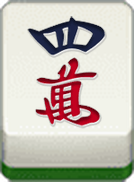
In this case the decision is easy — 4 Wan is from the void suit and must go. In later turns, when you have cleared your void suit, you will need to make more strategic discard decisions based on your hand shape.
6. Step 5 — Winning: Completing Your Hand
You win when your 14 tiles form a complete hand with zero void suit tiles. The two main winning structures are:
- Standard hand: 4 sets (any mix of sequences and triplets) + 1 pair
- 7 Pairs : exactly 7 pairs of identical tiles
You can win either by drawing the winning tile yourself (self-draw) or by claiming a discard from an opponent as your winning tile (you cannot use Chi — claiming discards for sequences — but you can win on an opponent's discard if it completes your hand).
Here is a complete standard winning hand — 4 sequences + 1 pair, all Tong (single suit — a high-scoring hand):


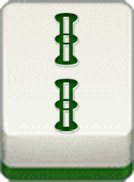
Here is a 7 Pairs winning hand — 2 suits (Tong + Tiao). Note: since the void suit cannot be held, a Seven Pairs hand uses at most 2 suits:
7. The Blood Battle Rule — Game Continues After First Win
This is what makes Blood Battle unique: the round does not end when the first player wins. Instead:
- The first winner declares their winning hand and their score is locked in
- The winning tiles are set aside; the remaining 3 players continue playing
- Play continues until either the wall runs out or another player wins
- Up to 3 players can win in a single round
- The player who never wins pays all winners
8. The Flower Pig Penalty
The Flower Pig (huā zhū) is a special penalty that triggers when:
- The wall runs out of tiles (the game ends without all players winning), AND
- You are still holding one or more tiles from your declared void suit
If you are caught as a Flower Pig, you pay a fixed penalty to every other player regardless of who won or lost. This makes it extremely important to discard your void suit tiles aggressively throughout the game — do not procrastinate.
9. Step 6 — Scoring: Fan Calculation
Blood Battle Mahjong uses a fan-based scoring system. Fan are multipliers: each additional fan doubles the payment.
| Hand Pattern | Fan Value | Notes |
|---|---|---|
| Standard Hand | 0 fan | Any valid 4-sets + 1-pair hand with no special pattern — base payout only |
| All Simples | 1 fan | No 1s or 9s anywhere in the winning hand |
| Terminals | 1 fan | Hand uses only 1s and 9s |
| All Triplets | 1 fan | All 4 sets are triplets — no sequences |
| Full Flush | 2 fan | All tiles in the winning hand from one suit only |
| Seven Pairs | 2 fan | Exactly 7 pairs of different tiles |
| Dragon Seven Pairs | 3 fan | Seven pairs with at least one quadruplet (4 identical tiles = 2 pairs) |
| Self-Draw Bonus | +1 fan | Added when you draw your own winning tile from the wall |
Fan values stack. For example: Qing Yi Se (4 fan) + self-draw (+1 fan) = 5 fan total. At 5 fan, each losing player pays you 32× the base amount. This is why single-suit hands are so highly prized — the fan multiplier explodes quickly.
10. Playing on realmahjong.ai
realmahjong.ai is designed specifically for English-speaking beginners learning Blood Battle Mahjong. Here are the features that help you during your first games:
- In-game hints: The game highlights recommended actions at each phase — which tiles to pass during exchange, which suit to declare void, which tiles to discard, and when to Pong or win
- Autopilot mode: If you are unsure what to do, you can let the AI play a turn for you while you watch and learn the reasoning
- AI assistant: An in-game chat assistant powered by Claude can answer rule questions during play in plain English
- Room tiers: Start in beginner rooms with lower stakes until you feel comfortable, then progress to higher-tier rooms
- Free to play: The game is completely free — coins are earned through gameplay, no payment required
- Blood Battle
- The defining rule: the round continues after the first winner. The last non-winner pays all winners.
- Deal
- Distributing tiles at the start of a round. Dealer gets 14 tiles; all others get 13.
- Wall
- The draw pile of face-down tiles shared by all players. Each player draws from the wall on their turn.
- Tile Exchange
- Before play begins, each player passes 3 same-suit tiles to another player. Direction is random each round.
- Void Suit
- The one suit your winning hand will not use. Declared before play begins. You must discard all void suit tiles.
- Pong
- Claiming an opponent's discard to complete a triplet. The triplet is revealed as an open meld visible to all.
- Kong
- Four identical tiles. Grants a bonus draw from the wall. Can be declared on your own draw or an opponent's discard.
- Self-Draw
- Winning by drawing your own winning tile from the wall. Adds +1 fan to your score.
- Win on Discard
- Winning by claiming another player's discarded tile as your winning tile.
- Fan
- Scoring multiplier. Each additional fan doubles the payment. Fan values stack.
- Flower Pig
- Penalty for holding void suit tiles when the wall runs out. You pay all other players a fixed penalty.
- No Chi Rule
- In Blood Battle, you cannot claim discards to form sequences. Sequences must be completed by drawing from the wall yourself.